
Why this page has no price list
Plenty of sites post a national range per square foot. The low end and the high end sit so far apart they don't help you plan, and they rarely include the prep your wall actually needs. A number for your house is more useful, and it starts with a few photos.
What follows is what moves that number up or down, so a quote makes sense when you get one.
The stone
Natural thin veneer costs more as material than manufactured stone. Within natural stone, the type changes the price. A common fieldstone isn't priced like squared granite that has to be cut to a pattern, and stone with an unusual color or a long trip from the quarry costs more.
Stone is sold two ways. Flat pieces go by the square foot. Corner pieces, the L shaped ones that wrap an outside corner, go by the linear foot, and they cost more because each one is cut from a bigger stone.
Size, corners and openings
Square footage is the base of any estimate. After that, shape matters. A plain stretch of foundation is about the simplest wall there is. Every corner and every thing mounted on the wall means cutting and fitting around it.
Columns show this well. A square deck post is almost all corner, so a small column can cost more per square foot than a long flat wall.
- Outside corners and how many linear feet of them
- Windows and doors that need returns or stone sills
- Vents, outlets, lights, hose bibs and meters on the wall
- Caps on top of knee walls and wainscot
Height, staging and getting stone to the wall
A foundation gets done from the ground. A chimney or a gable end needs staging, and staging takes time to set up, move and take down. Every stone also has to get carried up to where it goes.
Access counts on lake lots. A house at the bottom of a steep driveway, or a wall on the water side with no room for equipment, means more stone moved by hand and wheelbarrow. Distance plays in too. Kevin works out of Ossipee and covers towns across the Lakes Region and up into the Mount Washington Valley.
Prep work you never see
On a framed wall, stone can't go on until the siding comes off and the wall gets its water barrier, lath and scratch coat. Flashing at windows, roof lines and the bottom edge has to be right too. None of it shows when the job is done, and all of it is part of the price.
Concrete foundations are simpler when the surface is clean and unpainted. Painted, sealed or crumbling concrete needs work first so the mortar has something to grab. Sometimes the grade along the house has to come down so the stone can stop above the ground the way it should.
Pattern, joints and the look you want
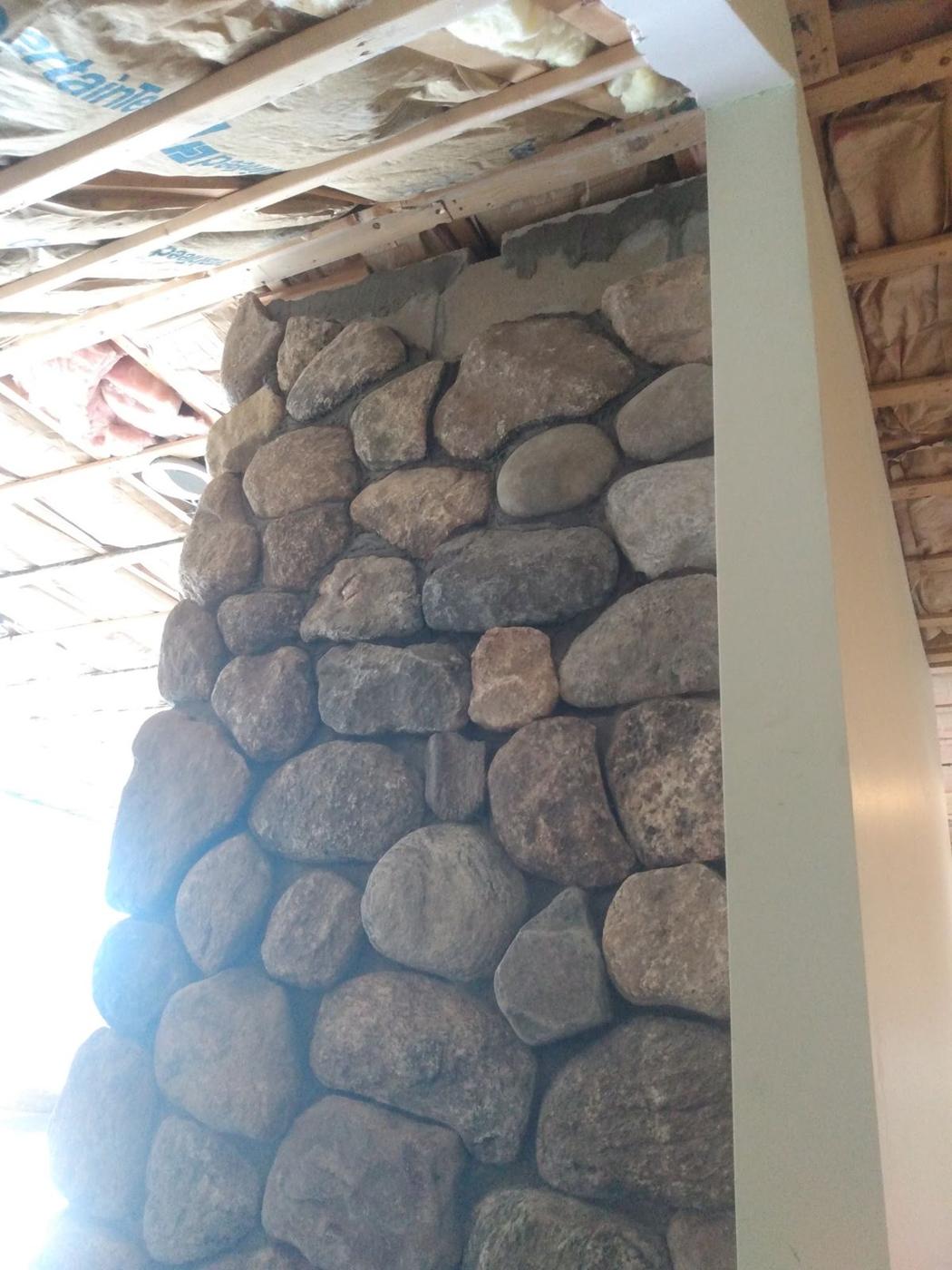
A tight fitted look, with thin joints and every stone shaped to its neighbor, takes more cutting and more hours than a looser pattern with wider joints. A squared ashlar pattern needs stone sorted and cut to set sizes. A round fieldstone wall means a lot of picking through the pile for the right shape. Same square footage, very different labor.
Inside work, like a fireplace surround, brings its own steps: working around the firebox, the hearth and the mantel, in a room people live in.
How to get a real number
Text Kevin at (603) 581-5350. The line is open 7am to 10pm, every day, so an evening text is fine. These make the first conversation useful:
- A wide photo of the whole wall and one close up
- Rough measurements, even paced off
- The town the house is in
- A photo of a stone or style you like, if you have one
- What the wall is now: poured concrete, block, or framed with siding